MeetYourClinic Editorial Team
Medical Tourism Research · Updated Mar 2026
Quick Summary
Turkey's dental tourism sector generated $184 million in 2024, with implants accounting for 42% of revenue. This guide covers 2026 costs, All-on-4 vs All-on-6, Straumann vs Osstem, clinic selection criteria, real patient experiences, and everything you need to know before booking.
Turkey has become the world's leading destination for dental implant treatment abroad. In 2023, over 400,000 international patients travelled to the country specifically for dental procedures, with implants representing the single largest treatment category — accounting for approximately 42% of Turkey's dental tourism revenue.[1] The broader market continues to accelerate: Turkey's dental tourism sector generated an estimated $184 million in 2024 and is projected to reach $532 million by 2033, growing at a compound annual rate of 12.5%.[2] This growth is part of a much larger global trend — the worldwide medical tourism market is valued at approximately $46.78 billion in 2026 and is projected to reach $250 billion by 2034, with dental procedures among the fastest-growing segments. Turkey's position as a top-four global destination for medical tourism, alongside Thailand, India, and Mexico, continues to strengthen — at the 29th EMITT Exhibition in Istanbul (February 2026), the Health Tourism Specialized Section was the most visited hall of the entire event, with 650+ exhibitors from 109 countries.[13]
The appeal is straightforward. A single dental implant in Turkey costs between $400 and $800, compared to $3,000 to $5,000 in the United States or £1,500 to £2,500 in the United Kingdom.[3] Full-mouth restorations using All-on-4 or All-on-6 systems cost a fraction of Western prices, and most clinics bundle the procedure with hotel accommodation, airport transfers, and follow-up care. Modern dental implants achieve success rates of 95 to 98%, with properly maintained implants functioning beyond 25 years according to a 2024 review in the Journal of Oral Implantology.[4]
But not every clinic delivers the same standard of care. A British Dental Association (BDA) survey found that 95% of UK dentists have examined patients returning from dental treatment abroad, and 86% have treated cases with complications — with implants identified as one of the treatments most likely to require follow-up work.[5] The quality gap between Turkey's best implant clinics and its worst is significant, and understanding what separates them is the most important research you can do before booking.
This guide breaks down everything you need to know about getting dental implants in Turkey in 2026: realistic costs, implant types and techniques, how to choose a clinic, what real patients say, the treatment timeline, and how to minimise risk.
Why Turkey Became a Global Leader in Dental Implants
Turkey's dominance in dental tourism did not happen overnight. It is the product of decades of investment in healthcare infrastructure, a strategic geographic position, and economic conditions that make world-class treatment accessible at a fraction of Western prices.
The Turkish government has actively supported medical tourism through tax incentives for accredited clinics and the establishment of USHAŞ, the state health tourism coordination agency.[6] Turkey now hosts over 50 JCI-accredited hospitals, and Istanbul alone has more than 1,300 dental clinics competing for international patients.[7] This competition has driven both prices down and quality up among the top-tier providers.
Geography plays a role too. Istanbul sits within a four-hour flight of over a billion people across Europe, the Middle East, and North Africa. Turkish Airlines operates one of the world's largest route networks, and patients from London, Berlin, Dubai, and Riyadh can arrive, consult, and begin treatment within the same day.
The economic case is compelling. Lower operational costs — clinic rent in Istanbul averages roughly £1,800 per month compared to £8,000 or more in London — combined with lower staff costs and a favourable exchange rate allow Turkish clinics to offer premium implant brands at prices that would be impossible in Western markets. Crucially, Turkish dentists graduate without the massive student debt common in the US and UK, which means they do not need to charge high fees to recoup educational costs.[7]
How Much Do Dental Implants Cost in Turkey in 2026?
Dental implant pricing in Turkey depends on three primary factors: the implant brand, the type of restoration, and whether additional procedures such as bone grafting or sinus lifts are required. Most clinics offer all-inclusive packages that bundle the implant, abutment, crown, imaging, consultation, hotel accommodation, and transfers into a single quoted price.
Cost Comparison by Treatment Type
| Treatment | Turkey | UK | US | Savings |
|---|---|---|---|---|
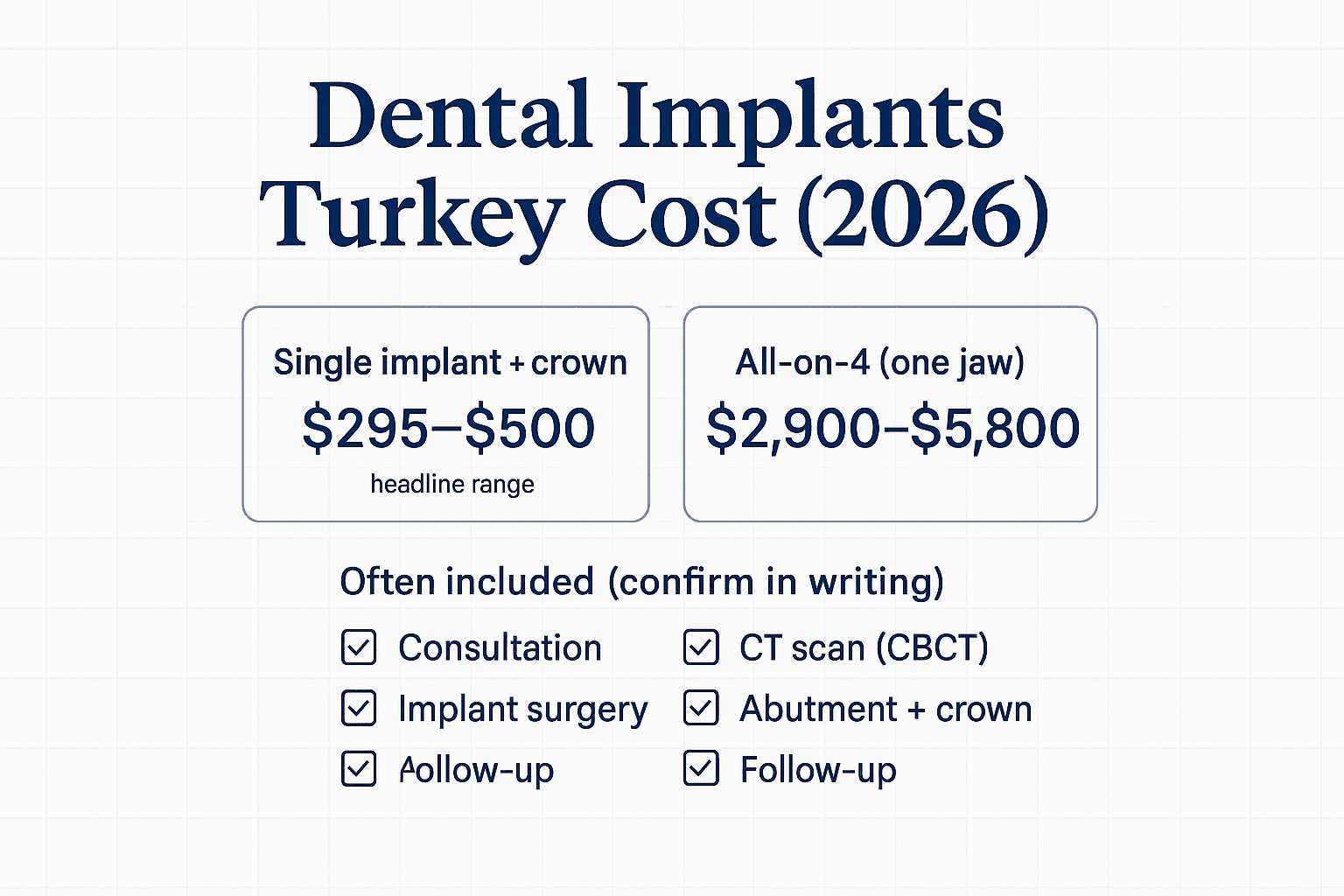
| Single implant (with crown) | $400 – $900 | £1,500 – £2,500 | $3,000 – $5,000 | 60–80% |
| All-on-4 (per jaw) | $2,500 – $5,500 | £7,000 – $10,000 | $15,000 – $30,000 | 65–85% |
| All-on-6 (per jaw) | $3,500 – $7,500 | £9,000 – £14,000 | $20,000 – $35,000 | 65–80% |
| Full mouth (both jaws, All-on-4) | $5,000 – $10,000 | £14,000 – £20,000 | $30,000 – $60,000 | 70–85% |
| Bone grafting (if needed) | $200 – $500 | £500 – £1,200 | $800 – $3,000 | 60–75% |
| Sinus lift (if needed) | $300 – $700 | £800 – £1,500 | $1,500 – $3,000 | 60–75% |
Sources: Pricing ranges compiled from clinic surveys, Bookimed verified clinic data (February 2026)[8], Grand View Research Turkey Dental Tourism Market Report (2024)[2], and ADA/BDA benchmarks (2024–2025).
What Is Typically Included in a Turkey Dental Implant Package
- ✓ Initial consultation with panoramic X-ray and 3D CT scan
- ✓ Personalised treatment plan reviewed by the implantologist
- ✓ The implant placement surgery (including local anaesthesia)
- ✓ Premium implant brand (Straumann, Nobel Biocare, or Osstem)
- ✓ Abutment and permanent crown (zirconia or porcelain)
- ✓ Temporary teeth (for All-on-4/6 procedures)
- ✓ Medications (antibiotics and pain relief)
- ✓ Hotel accommodation (typically 4–5 star, 3–7 nights)
- ✓ VIP airport transfers and clinic transport
- ✓ Follow-up consultations via video call for 12 months
Flights are not included, but return flights from London to Istanbul typically cost £100 to £300, and from New York approximately $400 to $700 depending on the season. Even with travel factored in, the total cost for a complete dental implant experience in Turkey remains substantially below domestic pricing in most Western countries.
What Affects the Price
The implant brand is the single biggest price variable. Premium Swiss and Swedish systems like Straumann and Nobel Biocare command higher prices but come with extensive clinical research backing their long-term performance. Korean brands like Osstem and MegaGen offer a more affordable option with solid clinical track records. Be cautious of clinics advertising prices significantly below $300 per implant — this may indicate unverified brands or compromised protocols.
Types of Dental Implants: Which One Is Right for You?
Understanding the different implant systems available in Turkey will help you make an informed decision during your consultation. The right choice depends on how many teeth you are replacing, the condition of your jawbone, and your budget.
Single Tooth Implants
A single titanium post is surgically placed into the jawbone to replace one missing tooth. After osseointegration (the process where bone fuses with the implant over three to six months), a permanent crown is attached. This is the most straightforward implant procedure and is suitable for patients missing one or a few non-adjacent teeth.
All-on-4 Implants
The All-on-4 system uses four strategically placed implants per jaw to support a full arch of fixed teeth. Two implants are placed vertically at the front and two at an angle at the back, maximising bone contact and often eliminating the need for bone grafting. Patients typically receive temporary fixed teeth on the same day as surgery, with permanent prosthetics fitted after three to six months of healing. This technique was developed by Nobel Biocare and has been extensively validated in peer-reviewed research over more than two decades.
All-on-6 and All-on-8 Implants
These systems follow the same principle as All-on-4 but use six or eight implants per jaw for additional stability and load distribution. They are generally recommended for patients with lower bone density or those who want maximum long-term security. The additional implants provide redundancy — if one implant were to fail, the prosthesis remains supported.
Zygomatic Implants
For patients with severe bone loss in the upper jaw who cannot undergo conventional implant placement, zygomatic implants anchor into the cheekbone (zygoma) rather than the maxillary bone. This is a specialised procedure available at only a handful of clinics in Turkey and requires a surgeon with advanced training.
Implant Brands Available in Turkey
| Brand | Origin | Price Range (Turkey) | Key Advantage |
|---|---|---|---|
| Straumann | Switzerland | $600 – $900 | Most extensively researched; 50+ years of clinical data |
| Nobel Biocare | Sweden | $550 – $850 | Pioneer of All-on-4; excellent long-term outcomes |
| Osstem | South Korea | $350 – $550 | Strong value proposition; widely used across Asia and Europe |
| MegaGen | South Korea | $350 – $500 | AnyRidge system for challenging bone conditions |
| Medentika/Implantswiss | Germany/Switzerland | $400 – $650 | Compatible with major systems; good mid-range option |
Ask your clinic to confirm the exact implant brand in writing before treatment. Reputable clinics will provide an implant passport documenting the brand, model, batch number, and placement details.
How to Choose a Dental Implant Clinic in Turkey
The quality gap between clinics in Turkey is wider than in most Western countries, precisely because the market is so large and competition is intense. At the top, you will find surgeon-led facilities with international accreditation and meticulous patient protocols. At the bottom, some clinics prioritise volume over quality and cut corners that can lead to complications.
Here are the critical factors to evaluate:
Surgeon Credentials and Specialisation
Dental implant placement should be performed by a specialist — an oral and maxillofacial surgeon, a periodontist, or a prosthodontist with specific implantology training. General dentists placing implants without advanced training represent a higher risk profile. Ask the clinic directly: who performs the surgery, what are their qualifications, and how many implant procedures have they personally completed? A surgeon with over 1,000 implant placements is a positive indicator.
Accreditation and Facility Standards
Look for clinics operating within JCI-accredited hospitals or holding Turkish Ministry of Health certification and international accreditations such as ISO 9001 or AACI. These facilities are subject to regular inspections covering hygiene, sterilisation, equipment standards, and emergency protocols. Be aware that the majority of Turkey's dental clinics are not JCI accredited — accreditation is a meaningful differentiator.
Technology and Equipment
Leading implant clinics in Turkey use 3D cone beam computed tomography (CBCT) for pre-surgical planning, computer-guided implant placement for precision, and CAD/CAM systems for same-day prosthetic fabrication. These technologies improve accuracy, reduce surgical time, and enhance outcomes. Ask whether the clinic uses guided surgery protocols.
Before and After Evidence
Request unedited before and after photographs, ideally at multiple post-operative stages (immediately after, three months, six months, and twelve months or more). For All-on-4 cases, ask to see the final prosthetics, not just temporary teeth. Be cautious of clinics that only show images taken immediately after surgery.
Aftercare and Warranty
Dental implants require ongoing maintenance, and complications can arise weeks or months after the procedure. Ensure the clinic provides a clear aftercare protocol, a written warranty on both the implant and the prosthetic components, and accessible post-operative support via WhatsApp or video call. The best clinics offer a lifetime warranty on the implant itself and a 5 to 10 year warranty on the crown or bridge.
Ready to Compare Clinics?
Get verified quotes from top-rated dental clinics. Compare prices and reviews in minutes.
Real Patient Experiences: What People Actually Say
We reviewed hundreds of patient testimonials across Trustpilot, Google Reviews, Reddit, and independent dental tourism forums to identify the consistent themes that emerge from real dental implant experiences in Turkey.[9][10]
What Patients Consistently Praise
"I'm 58, had three failed NHS implant referrals over two years — kept being told the waiting list was 14 months minimum. Flew to Istanbul for All-on-4 on my upper jaw. Straumann implants, the lot. Day one was the CT scan and consultation, day two was surgery under sedation — honestly the worst part was the anaesthetic wearing off that evening. Paracetamol and ibuprofen handled it. By day four I had temporary teeth fitted and could eat soft food. The hotel was a proper four-star, not some backpacker place. My coordinator Elif messaged me every morning on WhatsApp to check how I was doing. Total cost was £4,200 including hotel and transfers. My UK quote from a private clinic was £14,500 for the same Straumann system. I'm flying back in April for the permanent zirconia bridge."
— Trustpilot reviewer, All-on-4 upper jaw, Istanbul (January 2025)
"Did six individual implants across both jaws — three upper, three lower, all Osstem brand. I was nervous because I'd read horror stories, so I spent three months researching before I booked. Had two video consultations with the surgeon beforehand, which made a big difference. The surgery itself took about four hours total over two sessions. Swelling was significant for the first three days, looked like a hamster, but by day five I felt mostly normal. It's now been eight months, osseointegration is complete, and I'm getting my crowns fitted next month on my second trip. One thing I'd say — budget for the second flight. Nobody mentions that."
— Reddit, r/DentalTourism, 6-implant patient, Antalya (2025)
Across hundreds of reviews, the most frequently praised aspects include: the seamless logistics of all-inclusive packages (airport pickup, hotel, clinic transfers), the thoroughness of pre-surgical digital planning with 3D CT scans, the responsiveness of WhatsApp-based aftercare in the weeks following surgery, and the overall value compared to domestic pricing. Patients who had video consultations before travelling report significantly higher satisfaction.[9]
Common Concerns and Realistic Expectations
"I went to a clinic in Istanbul that was advertising single implants for $250. When I arrived they told me I needed bone grafting on three sites which added another $1,500 to the bill. The surgeon was fine — qualified, professional — but I felt blindsided by the upsell. My advice: get a full treatment plan with itemised costs BEFORE you fly. If a clinic can't give you that from an X-ray you send over, that's a warning sign."
— Trustpilot reviewer, 2 implants + bone graft, Istanbul (2024)
"Had All-on-6 on my lower jaw, went well initially. But one implant failed at the five-month mark — the clinic said it happens in about 3% of cases and they'd replace it free on my second trip. To be fair they did, no extra charge, but it meant a third flight to Turkey which I hadn't planned for. The final result is good, I'm happy, but people should know that implant failure is a real possibility even with a good clinic and it adds time and cost to the process."
— Google Reviews, All-on-6 patient, Istanbul (2025)
The most common concerns across independent platforms focus on: unexpected additional costs for bone grafting or sinus lifts that were not flagged during the initial consultation, the reality of needing two or three trips rather than one, the shedding period where temporary prosthetics feel loose before permanent ones are fitted, and the challenge of managing complications remotely from the UK.
Red Flags Checklist
- ✗ Prices significantly below market rate (under $300 for a single implant including crown)
- ✗ No video consultation offered before travel
- ✗ Vague about which surgeon will perform the procedure
- ✗ Pressure to book immediately with large upfront deposits
- ✗ No written treatment plan provided before arrival
- ✗ Clinic does not specify the implant brand being used
- ✗ No clear aftercare protocol or warranty documentation
The Treatment Timeline: What to Expect Day by Day
Dental implant treatment in Turkey can follow either a single-trip or two-trip protocol, depending on the type of procedure and your bone condition.
Single Implant Timeline (One Trip, 5–7 Days)
Day 1: Consultation and Planning. You arrive at the clinic for a comprehensive examination including panoramic X-ray, 3D CT scan, and clinical assessment. The implantologist reviews your bone density, identifies the optimal implant position, and confirms your treatment plan. If immediate loading is suitable for your case, the process can be completed in one trip.
Day 2: Implant Placement. The titanium implant is surgically placed into the jawbone under local anaesthesia. The procedure typically takes 30 to 60 minutes per implant. For immediate loading cases, a temporary crown is fitted on the same day.
Days 3–5: Recovery and Monitoring. You rest at the hotel with prescribed medications. The clinic schedules a follow-up visit to check the surgical site, remove any sutures, and provide aftercare instructions.
Day 6–7: Final Check and Departure. A final examination confirms healing is progressing normally. For conventional loading, you receive a healing cap and will return in three to six months for the permanent crown. For immediate loading, the temporary crown is checked and adjusted.
All-on-4 / Full Mouth Timeline (Two Trips)
Trip 1 (5–7 Days): Consultation, extractions if needed, implant placement, and fitting of temporary fixed teeth on the same day or within 24 hours. You leave Turkey with a functional set of temporary teeth.
Healing Period (3–6 Months): The implants undergo osseointegration while you use the temporary teeth. Remote check-ins via video call monitor progress.
Trip 2 (3–5 Days): The permanent prosthetic (typically zirconia or porcelain-fused-to-metal) is fitted, adjusted for bite and aesthetics, and permanently secured. Final X-rays confirm everything is in order.
Risks and How to Minimise Them
Dental implant surgery is generally safe when performed by qualified professionals in properly equipped facilities, but it carries inherent risks that patients should understand before proceeding.
The most common risks include implant failure during osseointegration (occurring in approximately 2 to 5% of cases), infection at the surgical site, nerve damage causing numbness or tingling in the lip or chin, sinus complications for upper jaw implants, and peri-implantitis — an inflammatory condition that can lead to bone loss around the implant over time.[4]
A 2025 study analysing over 158,000 dental implants found an overall failure rate of just 2.21%, with most failures occurring within the first year after placement.[11] Risk factors for failure included smoking, implants placed in the upper molar region, and insufficient bone density.
The BDA has flagged specific concerns about dental tourism complications. Their survey found that two-thirds of UK dentists who treated returning patients reported remedial costs of at least £500, with one in five cases exceeding £5,000.[5] Over 40% of this remedial treatment was provided on the NHS, raising questions about the true cost of overseas complications.
How to Reduce Your Risk
- ✓ Choose a clinic with JCI, ISO, or AACI accreditation
- ✓ Verify the surgeon's credentials and specialisation in implantology
- ✓ Confirm the implant brand in writing before treatment
- ✓ Request a detailed written treatment plan including all costs
- ✓ Ask how many patients the surgeon treats per day (one to three is ideal)
- ✓ Follow aftercare instructions precisely, especially regarding smoking, diet, and oral hygiene
- ✓ Attend all scheduled follow-up appointments, including remote check-ins
- ✓ Register with a UK or home-country dentist who can provide local follow-up if needed
Best Time of Year to Get Dental Implants in Turkey
Unlike hair transplants, dental implant procedures are not significantly affected by seasonal factors such as sun exposure. However, practical considerations still apply.
Spring (April to June) and autumn (September to November) are the busiest periods for dental tourism in Turkey, which means the most sought-after surgeons may have longer wait times. Winter months (December to February) offer easier scheduling, shorter wait times, and the most competitive pricing as clinics run promotions during the quieter season. Summer (July and August) can be extremely hot in Istanbul, which some patients find uncomfortable during recovery, though the clinics themselves are fully air-conditioned.
If your treatment requires two trips, plan the first trip during a quieter period and schedule the second trip three to six months later.
Find Your Dental Implant Clinic in Turkey
Ready to take the next step? MeetYourClinic connects you with verified, accredited dental implant clinics across Istanbul and Turkey. Compare prices, read patient reviews, view before-and-after galleries, and request free consultations — all in one place.
Browse dental implant clinics in Turkey →
Sources & References
- FineUp Clinic / Turkey Health Tourism Statistics 2024. Health Tourism Statistics in Turkey 2024: Dental Tourism
- Grand View Research. Turkey Dental Tourism Market Size & Outlook, 2025–2033. Market Report
- Kristal Clinic. Dental Implants Turkey Cost: 2025 Price & Safety Guide. Cost Guide
- Journal of Oral Implantology (2024). Long-term Success Rates of Dental Implants. Also: Schwimmer Dental, Dental Implant Statistics for 2025. Source
- British Dental Association (BDA). Dental Tourism: Patients Need to Know the Risks. BDA Survey
- New Health Media. Turkey's 2024 Health Tourism Data. Article
- CliniQuePlus. Dental Implant Cost Turkey vs USA/Canada 2025: Complete Price Guide. Guide
- Bookimed. All-on-4 Dental Implants in Turkey – Costs and Packages 2026. Verified clinic data, February 2026. Source
- Dentatur. Dental Implants Turkey: Full Mouth Packages, Results, Costs. Reviews & Results
- Turkey Luxury Clinics. All-Inclusive Dental Implant Packages in Turkey 2026. Packages
- Goker F, et al. "Dental Implant Survival Rates: Comprehensive Insights from a Large-Scale Electronic Dental Registry." Dentistry Journal. 2025;13(2). PubMed/PMC
- Brånemark Clinic, Gothenburg. "Outcome of Single Dental Implants Over 38–40 Years: A Long-Term Follow-Up Study." Clinical Implant Dentistry and Related Research. 2025. PubMed/PMC
- SNS Insider. Dental Tourism Market Size, Share & Growth Report 2032. Turkey data: 1.8 million healthcare tourists, $3.1 billion revenue (2023). Report
Frequently Asked Questions
A single dental implant with a crown costs between $400 and $900 in Turkey, compared to £1,500 to £2,500 in the UK and $3,000 to $5,000 in the US. All-on-4 full-arch restorations range from $2,500 to $5,500 per jaw. Most all-inclusive packages include hotel accommodation, airport transfers, 3D imaging, and aftercare. The exact price depends on the implant brand, the complexity of the case, and whether additional procedures such as bone grafting are required.
Yes, when performed by a qualified specialist in an accredited facility. Dental implants have a global success rate of 95 to 98%. Turkey's top clinics use the same premium implant brands (Straumann, Nobel Biocare) as Western practices and hold international accreditations. However, the BDA has documented that 86% of UK dentists have treated complications from overseas dental work, so choosing the right clinic is critical.
For a single implant, plan for five to seven days. For All-on-4 or full-mouth restorations, the first trip typically requires five to seven days, with a second trip of three to five days after three to six months of healing. Some clinics offer same-day implant protocols for suitable candidates.
Reputable Turkish clinics use internationally recognised brands including Straumann (Switzerland), Nobel Biocare (Sweden), Osstem (South Korea), and MegaGen (South Korea). Always confirm the exact brand in writing and request an implant passport after the procedure. Be cautious of clinics that do not disclose the brand they use.
The procedure is performed under local anaesthesia and is not painful during surgery. Most patients report mild to moderate discomfort for two to three days after the procedure, managed with prescribed pain medication. Full-mouth procedures under sedation or general anaesthesia are available at some clinics for patients with dental anxiety.
With proper care and regular dental check-ups, dental implants can last a lifetime. The titanium post itself is designed to be permanent. The crown or prosthetic attached to the implant typically lasts 10 to 20 years before it may need replacement. A 2025 long-term study from the Brånemark Clinic in Sweden demonstrated implant survival beyond 38 years.
Reputable clinics provide remote aftercare via WhatsApp or video call for at least 12 months. If a complication requires in-person treatment, the clinic's warranty should cover the cost of retreatment in Turkey. Some clinics also have partnerships with dentists in the UK and other countries for local follow-up. It is advisable to register with a local dentist before travelling so you have a point of contact for any urgent issues.
Yes. Many patients combine dental implants with veneers, crowns, or teeth whitening during the same trip. This is a common approach for full smile makeovers. Your treatment plan should account for the correct sequencing of procedures to optimise results and recovery.
Ready to Start Your Medical Journey?
Compare clinics, read verified reviews, and get personalised quotes from top medical facilities worldwide. Save up to 70% on your treatment.