MeetYourClinic Editorial Team
Medical Tourism Research · Updated Mar 2026
Quick Summary
DHI hair transplant prices in 2026 typically range from £2,500–£5,000 in Turkey and £7,000–£15,000 in the UK. This guide breaks down what drives the cost, what’s included, hidden extras, and the red flags to avoid.
Quick Summary
DHI (Direct Hair Implantation) is usually priced higher than standard FUE because implantation can be more labour-intensive and, in some clinics, involves more surgeon time and specialised tools (often an implanter pen system). In 2026, most UK patients researching DHI will see Turkey packages around £2,500–£5,000 and UK pricing around £7,000–£15,000, with big variation based on graft numbers, who does each step, and aftercare.
If you remember one thing: don’t compare quotes without comparing what’s actually included and who is doing the work. The cheapest DHI quote can become the most expensive once you add flights, extra nights, medication, and fix-ups.
Internal links you might want alongside this guide:
- /blog/fue-vs-dhi-hair-transplant-2026
- /blog/hair-transplant-cost-2026
- /blog/hair-transplant-cost-uk-2026
- /blog/hair-transplant-turkey-2026-guide
What “DHI” means (and why it affects price)
DHI is typically described as implanting grafts using an implanter pen so the site creation and placement happen in one motion, rather than placing into pre-made incisions. Different clinics use the term differently, which is exactly why cost comparisons get messy.
In practice, when UK patients are quoted for “DHI”, the quote can refer to:
- FUE extraction + implanter pen placement (common)
- FUE extraction + “DHI-style” dense packing (marketing language)
- A premium package level that includes more surgeon involvement, smaller daily patient volume, or enhanced aftercare
DHI can be a great option for some hairlines and density goals. But price should follow substance: tools, staffing, time, and accountability. If “DHI” is just a label on a high-volume package, you’re not paying for a better method, you’re paying for a nicer PDF.
DHI Hair Transplant Cost in 2026: UK vs Turkey
Below are the ranges patients most commonly see advertised or quoted when comparing reputable providers. Use them as a starting point, not a promise.
Table 1: Typical DHI price ranges (2026)
| Location | Typical patient-facing pricing | How it’s commonly sold | What usually drives the range |
|---|---|---|---|
| Turkey | £2,500–£5,000 | Package (often “up to X grafts”) | Hotel level, surgeon involvement, clinic volume, aftercare scope, whether PRP is bundled |
| UK | £7,000–£15,000 | Per graft, per session, or tiered packages | Grafts, surgeon time, clinic overheads, aftercare schedule, theatre standards |
These UK ranges align with publicly discussed UK market variation (with some clinics citing upper ends around £15,000 in recent analyses) [3].
Table 2: Per-graft vs package pricing (how quotes are structured)
| Pricing model | Where you’ll see it | Pros | Cons | Who it suits |
|---|---|---|---|---|
| Per graft (e.g., £3–£7 per graft) | Common in the UK; sometimes premium Turkey clinics | Transparent link between work volume and price | Clinics may inflate graft estimates; harder to budget if plan changes | Patients who want a precise plan and itemised quote |
| Fixed package (e.g., £3,500 “all-inclusive”) | Very common in Turkey | Easy to budget; flights aside, costs are predictable | “Unlimited grafts” claims; unclear staffing; corners can be cut | Patients who want simplicity but are willing to interrogate inclusions |
| Tiered packages (standard vs surgeon-led) | UK and Turkey | Forces a conversation about who does what | Some tiers are pure marketing | Patients who care about surgeon involvement |
Table 3: What actually drives DHI price (in plain English)
| Cost driver | Why it changes the price | What to ask |
|---|---|---|
| Graft count | More grafts means longer extraction + longer implantation, more staff time | “What graft range are you estimating and why?” |
| Surgeon involvement | Surgeon-led design, anaesthetic, extraction, and placement costs more | “Which steps does the surgeon personally perform?” |
| Daily patient volume | High-volume clinics lower prices by running multiple patients per day | “How many patients per day does the surgical team treat?” |
| Implanter pen technique and team skill | DHI placement is skill-dependent and can be slower | “How is graft handling managed to minimise out-of-body time?” |
| Aftercare and follow-up | More follow-up visits and support cost money | “What does aftercare include for 12 months?” |
| Complication cover / revisions | Some clinics price in a safety buffer, some don’t | “What happens if growth is poor or there’s a complication?” |
What’s usually included in a DHI quote (and what often isn’t)
One of the biggest reasons patients feel misled is not the headline number, it’s the gap between what they assumed was included and what the clinic meant. The NHS advises doing thorough research for cosmetic procedures and highlights the importance of safe, regulated providers [1]. That matters even more when you’re comparing international packages [2].
Commonly included (UK and Turkey)
Most DHI quotes include:
- Consultation and basic medical review
- Donor area extraction (almost always FUE-based)
- Implantation (sold as DHI, often with an implanter pen)
- Local anaesthetic
- Basic immediate post-op check
- Written aftercare instructions
Turkey packages often add:
- Airport transfers
- Hotel (usually 2–3 nights)
- Translator / patient coordinator
- A wash appointment before you fly home
Often NOT included (hidden costs to budget for)
Budget for these unless explicitly written into your quote:
- Flights and checked luggage
- Extra hotel nights if you need more recovery time
- Prescription medication (antibiotics, pain relief) and post-op products
- Time off work (this is a real cost for many people)
- Travel insurance that covers elective procedures and complications (many standard policies do not)
- Follow-up in the UK (GPs can help with basics, but private follow-up may be needed)
- Second procedure if you progress in hair loss over time
- Corrective work (if hairline design is poor, overharvested donor, or growth is weak)
The “second trip” nuance (important for Turkey)
A lot of packages are designed around one intensive visit. That is fine when:
- your case is straightforward,
- your aftercare is well explained,
- and you have a clear route for support once you’re home.
The problem is that hair transplantation is a long timeline. Early swelling, scabbing, and shedding are normal. But if you develop issues like infection, excessive pain, or donor complications, being 2,000 miles away changes the equation.
NHS guidance on cosmetic surgery abroad emphasises weighing savings against risk and planning for what happens if complications occur [2]. BAAPS also highlights that patients may face costs if they need correction back in the UK after surgery overseas [4].
That doesn’t mean “don’t go to Turkey”. It means budget like an adult:
- If you travel, assume you might need extra nights.
- Have a plan for remote follow-up and what’s considered urgent.
- Know who pays if you need a review in person.
Ready to Compare Clinics?
Get verified quotes from top-rated hair transplant clinics. Compare prices and reviews in minutes.
UK vs Turkey: why the gap can be so big
Patients usually assume the gap is purely “Turkey is cheaper”. The reality is more specific.
1) Overheads and staffing models
UK clinics have high fixed costs and stricter operating environments. Turkey’s hair transplant market has scaled via high patient volume and package-based operations.
2) Who does the surgery (and who you think does)
A key trust issue is the difference between:
- a named surgeon designing, extracting, and placing, vs
- a surgeon supervising while a team performs much of the procedure.
Your cost should reflect the true level of surgeon input. If a clinic won’t put that in writing, it’s a red flag.
3) “DHI” is not a regulated term
Clinics can label placement as DHI even when it’s essentially FUE with an implanter pen step. The technique may be similar, but the label can be used to justify higher pricing.
4) Case selection and promises
Some low quotes are only “low” because the clinic has assumed:
- a small graft number,
- minimal hairline refinement,
- aggressive extraction,
- or unrealistic donor capacity.
A safe plan may cost more because it’s designed for your long-term donor management.
A practical way to compare quotes (without losing your mind)
Here’s a comparison checklist you can copy into your notes. Ask every clinic the same questions and compare like-for-like.
Quote comparison checklist
- Estimated graft range (minimum and maximum) and what it’s based on (photos, video consult, in-person assessment).
- Who performs each step: hairline design, anaesthetic, extraction, graft sorting, implantation.
- Daily patient volume per surgeon and per tech team.
- Implantation method: pre-made incisions vs implanter pen, and who holds the pen.
- Donor management plan: how they avoid overharvesting and visible thinning.
- Aftercare: schedule, who reviews you, and how complications are handled remotely.
- Medication and products: included or charged separately.
- Refund/revision policy: what’s covered if growth is poor.
If you’re still choosing between FUE and DHI, start here: /blog/fue-vs-dhi-hair-transplant-2026
Red flags we see in DHI pricing (and what they usually mean)
The internet is full of “bargain DHI” offers. Some are fine. Some are chaos.
Red flag 1: “Unlimited grafts” or “5,000 grafts for everyone”
Grafts are not a buffet. Your donor area is finite. A clinic that pushes one-size-fits-all graft numbers may be optimising for throughput, not outcome.
Ask: “How many grafts do you think I can safely donate over my lifetime?”
Red flag 2: No named surgeon, or you can’t verify credentials
A trustworthy clinic will tell you who is responsible for your care.
In the UK, independent clinics providing cosmetic surgery in England must be registered with the Care Quality Commission (CQC), and the NHS explicitly advises checking this [1]. If a UK clinic can’t show its regulatory status clearly, walk away.
Ask: “What is your CQC registration (England) and can you send me the link?”
Red flag 3: The quote avoids specifics about who does implantation
DHI outcomes are highly dependent on placement skill and planning. If the clinic won’t answer, assume you won’t like the answer.
Ask: “Will the surgeon implant the grafts, or a technician team? How many years’ experience does the implanter have?”
Red flag 4: Pressure tactics and vanishing discounts
If the price is only valid “today”, that is not healthcare, that is a sales funnel.
Red flag 5: Aftercare that ends at the airport
Hair transplant recovery has milestones at weeks and months, not days.
Ask: “What follow-up do I get at 2 weeks, 3 months, 6 months, 12 months?”
Questions to ask a clinic before you pay a deposit
These questions are designed to reveal quality without needing to be an expert.
- “Who will design my hairline, and can I see examples of similar hairlines?”
- “How many patients will the surgeon oversee on my surgery day?”
- “What is your plan if I have shock loss or folliculitis?”
- “How do you store grafts and manage out-of-body time?”
- “What’s the realistic density expectation for my hair type?”
- “What happens if I lose more native hair over the next 5–10 years?”
- “Can I speak to a past patient with a similar pattern of loss?”
- “Is finasteride or minoxidil recommended for my case, and why?” (Only take medication advice from qualified clinicians.)
Example budgets (so you can plan properly)
These are not quotes. They’re realistic planning ranges to stop you being surprised later.
Example A: Turkey DHI package (typical)
- Package: £3,200–£4,500
- Flights: £200–£450
- Extra nights: £150–£400
- Meds/products: £50–£200
- Insurance upgrade: £80–£250+
Planning range: £3,700–£5,800
Example B: UK DHI (typical)
- Procedure: £7,000–£15,000
- Travel within UK: £50–£300
- Meds/products: £50–£200
Planning range: £7,100–£15,500
FAQs (real searches people type)
How much does DHI hair transplant cost in Turkey in 2026?
Most UK patients see Turkey DHI packages advertised around £2,500–£5,000. The figure can rise if you need more grafts, choose a surgeon-led package, upgrade accommodation, or add extra nights and insurance.
How much does DHI hair transplant cost in the UK in 2026?
UK pricing commonly lands around £7,000–£15,000, depending on graft numbers, clinic location and overheads, and how surgeon-led the procedure is.
Is DHI more expensive than FUE?
Often, yes. DHI placement can be slower and more labour-intensive, and some clinics position it as a premium service. But “DHI” is sometimes used as marketing language, so compare what’s actually being done, not the label.
How many grafts do I need and how does that change the price?
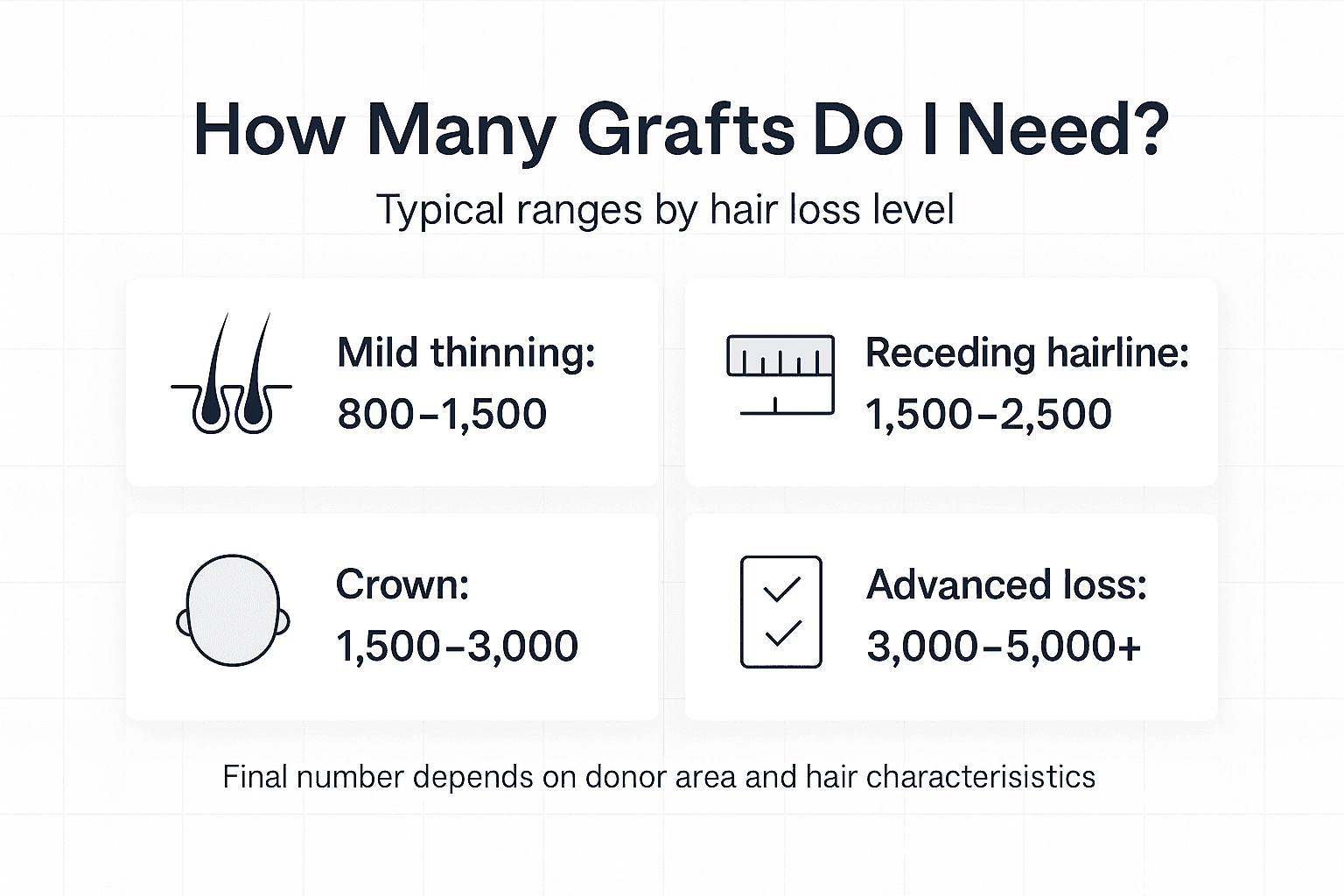
Graft needs depend on the size of the area, your current density, hair calibre, and long-term hair loss pattern. More grafts usually increases cost because it increases surgery time and staff time. Be cautious of clinics that estimate high graft numbers from a single blurred photo.
What is included in a DHI package in Turkey?
Many packages include the procedure, transfers, a hotel stay, and a wash appointment. Flights, extra nights, medication, and long-term follow-up are often extra. Ask for a written list before paying a deposit.
Are hair transplants regulated in the UK?
Cosmetic procedures provided by independent clinics in England must be registered with the CQC, and the NHS advises checking registration when researching hair transplants [1]. (Regulation differs across the UK nations, so ask what applies where the clinic operates.)
What are the biggest red flags when choosing a DHI clinic?
Common red flags include “unlimited grafts”, refusal to tell you who does the work, high-pressure deposits, and aftercare that ends immediately after you fly home. These are signals to slow down and get clarity.
Can I fly home right after a hair transplant?
Many patients do, but you should follow your clinic’s advice and plan for swelling and comfort. NHS advice on cosmetic surgery abroad stresses planning for safety and what happens if complications occur [2]. If you’re travelling, factor in the option of extra nights.
What questions should I ask a clinic about who does the surgery?
Ask exactly which steps the surgeon performs (hairline design, anaesthetic, extraction, incisions, implantation) and how many patients they oversee per day. Get the answer in writing.
Where can I learn about overall hair transplant costs (not just DHI)?
Start here:
- /blog/hair-transplant-cost-2026
- /blog/hair-transplant-cost-uk-2026
- /blog/hair-transplant-turkey-2026-guide
Sources
- NHS. Hair transplant (includes advice on choosing providers and checking CQC registration for cosmetic surgery in England). https://www.nhs.uk/tests-and-treatments/cosmetic-procedures/cosmetic-surgery/hair-transplant/
- NHS. Cosmetic surgery abroad (advice on researching providers and considering risks and complications). https://www.nhs.uk/tests-and-treatments/cosmetic-procedures/advice/cosmetic-surgery-abroad/
- Wimpole Clinic. Hair Transplant Cost UK analysis (example of UK market price variation up to ~£15,000). https://wimpoleclinic.com/blog/hair-transplant-cost-uk-analysis/
- BAAPS. Cosmetic Tourism (patient safety and the issue of dealing with complications after surgery abroad). https://baaps.org.uk/patients/safety_in_surgery/cosmetic_tourism.aspx
- ISHRS. 2022 Practice Census Results (global hair restoration market context). https://ishrs.org/wp-content/uploads/2022/04/Report-2022-ISHRS-Practice-Census_04-19-22-FINAL.pdf
- Treatment Rooms London. Direct Hair Implantation (DHI) / implanter pen overview (description of implantation using an implanter pen). https://www.treatmentroomslondon.com/hair-transplant-tips/direct-hair-implantation-implanter-pen-hair-transplants-what-you-need-to-know/
Ready to Start Your Medical Journey?
Compare clinics, read verified reviews, and get personalised quotes from top medical facilities worldwide. Save up to 70% on your treatment.