MeetYourClinic Editorial Team
Medical Tourism Research · Updated Mar 2026
Quick Summary
Hair transplant cost in 2026 varies widely by graft count, technique and surgeon involvement. This UK-focused guide compares UK vs Turkey pricing, explains what’s usually included, and shows how to spot hidden costs and red flags before you book.
Quick Summary (for UK patients)
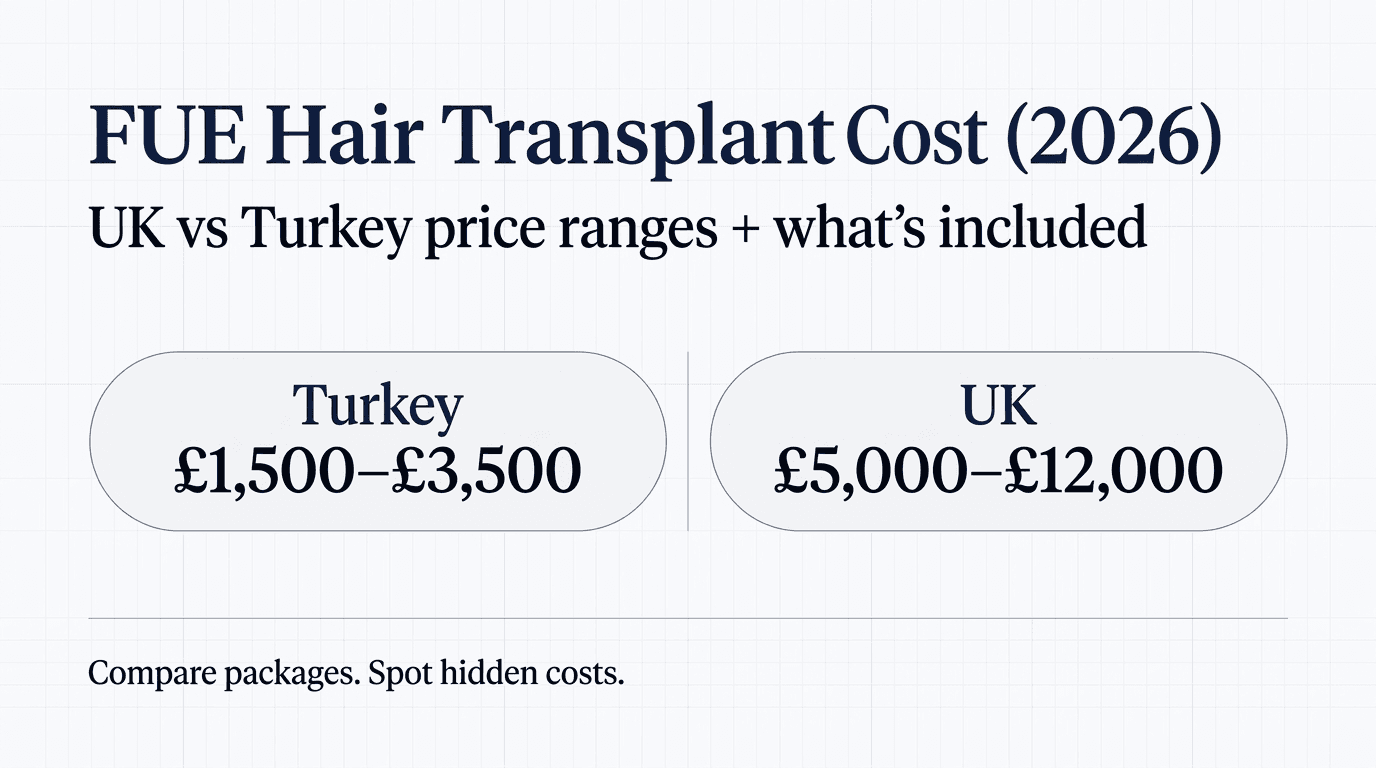
In 2026, hair transplant cost in the UK typically ranges from £3,000 to £12,000+, most often priced either per graft (commonly a few pounds per graft) or as a case-based package. Turkey is usually cheaper upfront, with many all-in packages around £1,500 to £4,500, but the headline price can hide extras like PRP, extra grafts, medication, and the true cost of fixing a poor result.
If you want the safest way to compare quotes, ask every clinic for the same four things: (1) confirmed graft range, (2) technique (FUE, DHI, Sapphire), (3) exactly who does extraction and placement, and (4) what aftercare and revision support is included. Cheap becomes expensive quickly if the surgeon is barely involved or the graft estimate is unrealistic.
Hair loss is emotional, and hair transplant pricing can feel deliberately confusing. Clinics mix “from” prices, graft estimates that shift on the day, and packages that include hotels but not the parts of care that actually matter.
This guide is a practical, UK-focused breakdown of what hair transplants cost in 2026, what drives the price up or down, what you should expect to be included, and how to spot red flags before you pay a deposit.
If you’re also weighing Turkey, this pairs well with our destination guide: Hair transplant Turkey 2026 guide. And if you like cost breakdowns that separate “headline price” from “real total cost”, our Turkey teeth cost 2026 guide uses the same method.
Hair transplant cost 2026: at-a-glance price ranges
These are realistic ranges for UK patients in 2026. Your quote depends on graft count, technique, surgeon involvement, and complexity.
UK vs Turkey: typical total prices (most common scenarios)
| Scenario (typical graft range) | UK (typical total) | Turkey (typical total, package-heavy market) | Notes |
|---|---|---|---|
| Small recession / temple work (800 to 1,500 grafts) | £3,000 to £6,000 | £1,500 to £2,800 | Temple angles are fiddly. Great planning matters more than saving £500. |
| Hairline + mid-scalp (1,800 to 3,000 grafts) | £6,000 to £10,000 | £2,000 to £3,800 | Many adverts quote “up to 4,000 grafts”. Treat “unlimited grafts” as a red flag. |
| Larger coverage / crown included (3,200 to 4,500 grafts) | £9,000 to £14,000+ | £2,800 to £4,500+ | Crown often needs staged planning. Dense-packing everything in one go can backfire. |
UK benchmark (per graft): one UK clinic analysis published in 2026 calculated an average of £3.25 per graft across their research sample, and shows example totals by graft count (e.g., 2,500 grafts ≈ £8,125 at that benchmark). [1]
Important: Turkey prices vary wildly by clinic model. Some quotes are cheap because surgeon time is minimal, and much of the work is done by technicians. ISHRS consumer guidance warns about “illicit” or “black market” clinics where non-doctors perform surgery and outcomes can be poor. [2]
How hair transplant clinics charge: per graft vs package pricing
You’ll see two main pricing models.
1) Per-graft pricing (common in the UK)
How it works: The clinic estimates a graft number (often a range) after assessment, then charges per graft.
Typical pros:
- Easier to compare if the graft count is realistic.
- More transparent if the quote is itemised.
Typical cons:
- Some clinics over-estimate grafts.
- If your plan changes on the day (it happens), your final bill can change.
What to ask: “What is the graft range and what is your plan if I need fewer or more grafts on the day?”
2) Fixed packages (common in Turkey)
How it works: You pay a set price for a “package” (often including hotel and transfers), usually with a maximum graft number.
Typical pros:
- Predictable headline price.
- Often includes logistics.
Typical cons:
- “Unlimited grafts” marketing encourages unsafe harvesting.
- Extra charges can appear for PRP, sedation, additional nights, or “extra grafts”.
What to ask: “What’s the maximum graft number included, and what happens if your assessment says I need more? Who makes that decision?”
Cost by technique: FUE vs DHI vs Sapphire (2026)
Technique affects staffing, time, and tool costs. It also affects what kind of clinic model you’re walking into.
Typical price differences
| Technique | What it is (plain English) | UK price tendency | Turkey price tendency | When it can be worth paying more |
|---|---|---|---|---|
| FUE | Follicles extracted individually, then placed into recipient sites (often via incisions then placement). | Baseline | Baseline | Most patients. Best value when surgeon planning is strong. |
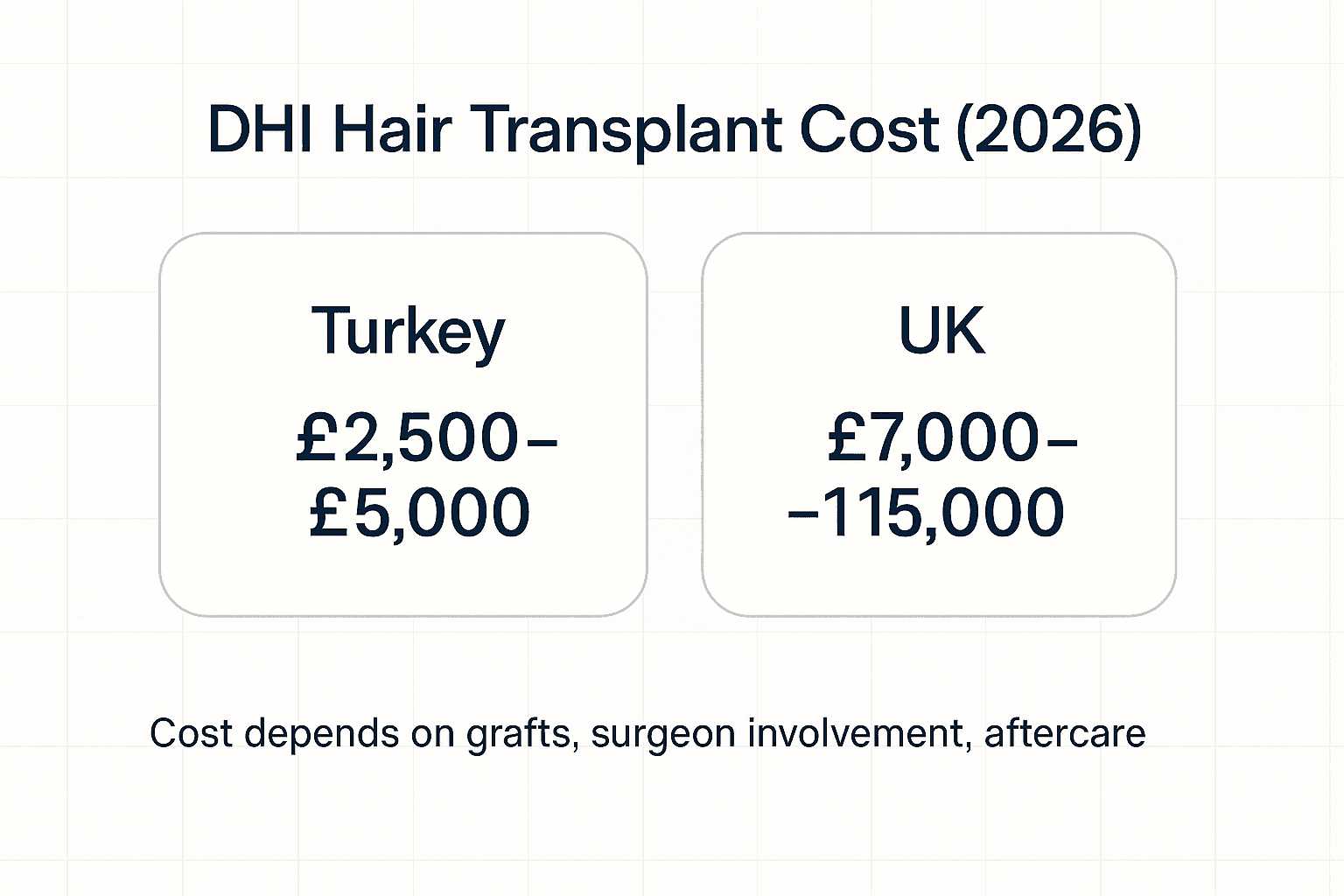
| DHI | FUE extraction, but placement uses an implanter pen (can allow tighter placement and less handling). | Higher | Higher | Small zones, complex hairlines, or when a clinic is genuinely skilled with DHI. |
| Sapphire FUE | FUE with sapphire blades for making recipient incisions (marketing varies). | Slightly higher | Slightly higher | Sometimes helpful, but do not treat the blade material as the deciding factor. |
Typical totals by technique (mid-range cases)
These are illustrative ranges for a common 2,000 to 3,000 graft case.
| Technique | UK total (typical) | Turkey total (typical) |
|---|---|---|
| FUE | £6,000 to £10,000 | £2,000 to £3,500 |
| Sapphire FUE | £6,500 to £11,000 | £2,300 to £4,000 |
| DHI | £7,000 to £12,000 | £2,500 to £4,500 |
Turkey price examples published by major transplant providers often place standard FUE around the low-thousands (in GBP-equivalent) and DHI/Sapphire higher. Treat these as marketing-led but still useful for ballpark ranges. [3][4]
What actually drives hair transplant cost (and what should not)
1) Graft count (the biggest driver)
More grafts generally means:
- Longer operating time
- More staff time
- More risk to graft survival if the workflow is rushed
But graft count isn’t a badge of honour. The right question is: How many grafts are needed for a natural-looking, age-appropriate plan, while protecting the donor area for the future?
2) Surgeon involvement (often the real difference)
If there’s one factor that should move the price, it’s who does the work and how closely it’s supervised.
A lot of “too good to be true” pricing relies on a production-line model where the surgeon’s role is limited. ISHRS consumer education specifically warns about clinics where non-doctors perform surgery and patients are put at risk. [2]
Practical questions to ask:
- “Who designs my hairline and makes the recipient sites?”
- “Who extracts the grafts?”
- “Who places the grafts?”
- “How many patients are being operated on that day, and how many are you personally responsible for?”
3) Your hair characteristics and complexity
Costs can rise when the case is harder, for example:
- Curly/Afro hair (extraction angle complexity)
- Scarring (older procedures, injuries)
- Limited donor supply
- Diffuse thinning (risk of shock loss, planning complexity)
4) Aftercare and follow-up support
A trustworthy quote should include:
- A clear aftercare plan
- A check-up schedule (even if virtual)
- A route for urgent concerns (infection, swelling, severe pain)
5) Add-ons: PRP, medications, and tests
Some add-ons are genuinely useful for some patients, but they’re frequently used to make a package look cheaper than it is.
Common extras that may cost more:
- PRP (platelet-rich plasma)
- Sedation
- Blood tests
- Post-op kit (shampoo, spray, pillows)
What’s usually included in a hair transplant quote (UK vs Turkey)
UK clinics: typical inclusions
Many UK quotes include the procedure, local anaesthetic, and follow-up. One UK clinic cost analysis describes graft pricing as typically covering the procedure, pre- and post-operative care, and essential recovery medications. [1]
Check what “essential medications” actually means (antibiotic, anti-inflammatory, pain relief), and whether hair-loss medicines (finasteride/minoxidil) are separate.
Turkey packages: typical inclusions
Many Turkey packages include:
- Procedure
- Hotel (2 to 4 nights is common)
- Airport transfers
- Translator or patient coordinator
- Basic post-op kit
Flights are usually not included. Neither is the cost of time off work, a travel companion, or the financial impact of needing revision.
Ready to Compare Clinics?
Get verified quotes from top-rated hair transplant clinics. Compare prices and reviews in minutes.
Hidden costs UK patients forget to budget for
Even when the transplant itself is priced clearly, your real total cost can be higher.
Travel and time off (especially for Turkey)
Budget for:
- Flights
- Extra nights if swelling or scabbing is worse than expected
- Food, taxis, and incidentals
- Lost income if self-employed
Medications and ongoing hair loss treatment
A transplant moves hair, it does not stop future loss. Many men (and some women) use finasteride and/or minoxidil to stabilise loss long-term. That ongoing cost can dwarf the price difference between clinics over a few years.
Revision or repair work
This is the most expensive “hidden cost”, because it’s not just money. It’s donor hair you cannot get back.
If you’ve had poor growth, pluggy grafts, a low unnatural hairline, or donor over-harvesting, repair can require:
- A second procedure
- Scalp micropigmentation
- Beard-to-scalp grafts
ISHRS campaigns highlight how damaging poorly performed procedures can be, particularly where clinics are operating outside normal medical standards. [2]
Red flags that often correlate with bad outcomes (and expensive fixes)
Use this as a practical checklist.
Pricing red flags
- “Unlimited grafts” or “guaranteed density” marketing
- One fixed price for everyone with no proper consultation
- Huge discounts if you pay today
- “Per graft” quotes that push graft numbers far beyond what your donor can support
Clinical red flags
- You cannot name the surgeon who will operate on you
- The clinic will not confirm who does extraction and placement
- They plan multiple patients per day with limited surgeon presence
- No clear plan for follow-up once you’re back in the UK
Behavioural red flags
- Dismissing your questions as “overthinking”
- Refusing to put the graft range and plan in writing
- Strong pressure to book flights before consultation
How to compare quotes properly (a simple method)
If you do nothing else, standardise the comparison.
Ask every clinic to answer these in writing:
- Graft range recommended (minimum and maximum) and what it’s based on.
- Technique and why it suits you.
- Who does what: hairline design, anaesthetic, extraction, incision-making, implantation.
- Daily schedule: how many patients that surgeon is responsible for that day.
- Inclusions: medication, aftercare appointments, post-op kit.
- Exclusions: PRP, sedation, extra grafts, extra nights.
- Revision policy: what happens if growth is poor.
This turns a confusing set of glossy PDFs into something you can compare line-by-line.
Cost by graft count (simple budgeting guide)
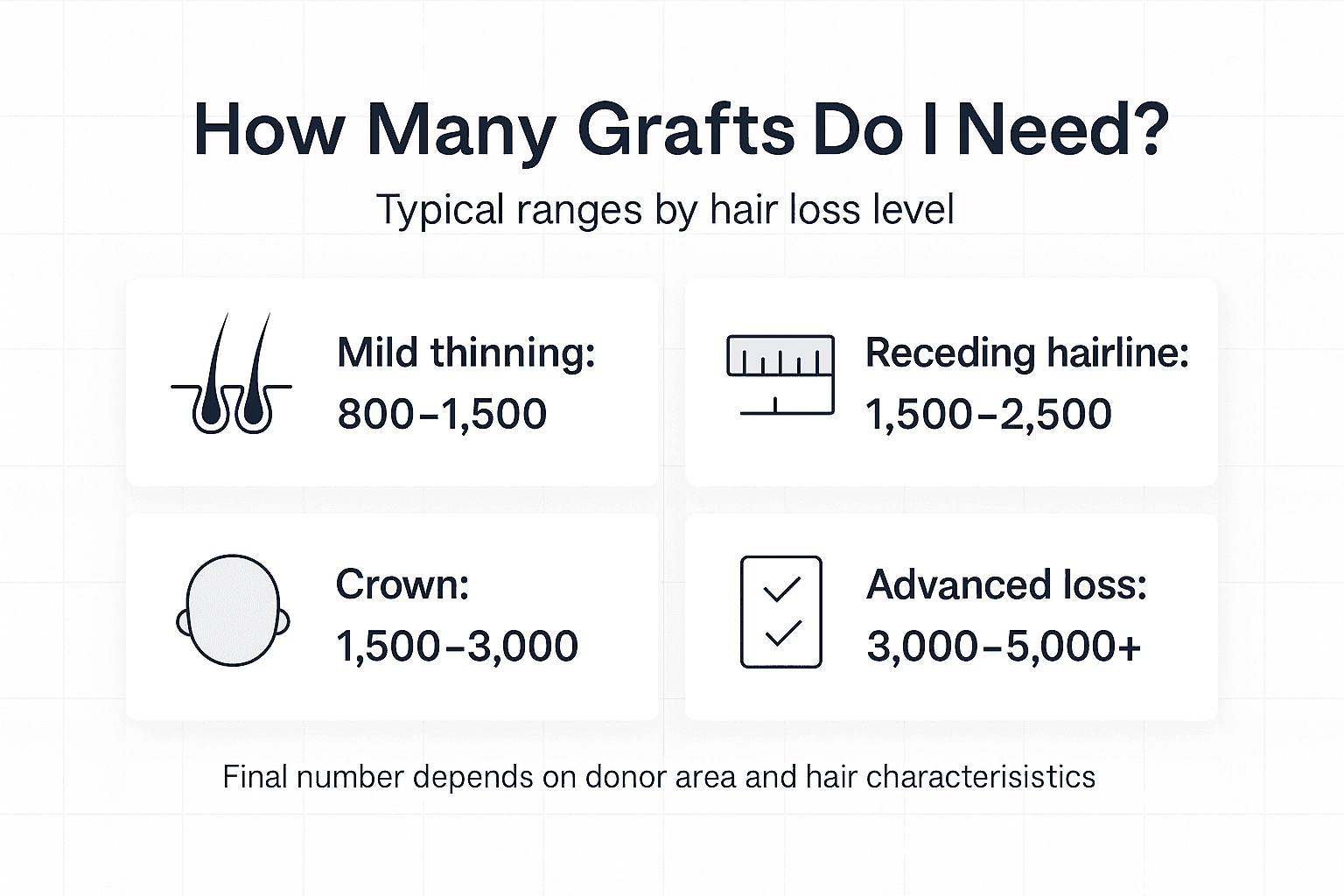
Clinics will often talk about “small”, “medium”, and “large” cases. If you prefer something you can put into a spreadsheet, start with a graft range.
Using the £3.25 per graft benchmark reported in a 2026 UK cost analysis (and remembering real quotes vary), you can sanity-check UK pricing quickly. [1]
| Grafts (rough range) | What it often covers | UK cost (approx at £3.25/graft) | Notes |
|---|---|---|---|
| 800 to 1,200 | Minor temples, small hairline refresh | £2,600 to £3,900 | Many clinics have minimum case fees, so the real quote may be higher. |
| 1,500 to 2,200 | Hairline + some mid-scalp | £4,900 to £7,150 | Often the “sweet spot” for noticeable improvement. |
| 2,500 to 3,200 | Hairline + mid-scalp, more density | £8,125 to £10,400 | Good planning is key to avoid over-harvesting. |
| 3,500 to 4,500 | Large areas, sometimes crown | £11,375 to £14,625 | Crown work may need staging to protect blood supply and donor reserves. |
Treat these numbers as a sense-check, not a promise. A high-quality clinic can cost more (more surgeon time, fewer patients per day, stronger follow-up). A cheap quote can also be expensive later if growth is poor or the donor is over-harvested.
Other destinations UK patients compare (briefly)
Turkey isn’t the only option. In 2026, UK patients also compare Spain, Poland, and Hungary. Prices shift with clinic reputation and the surgeon-led vs technician-led model, so use these as broad ranges only.
| Destination | Typical price tendency vs UK | Typical reasons patients choose it |
|---|---|---|
| Spain | Lower to similar | Easier travel, some strong surgeon-led clinics, good for follow-up trips. |
| Poland | Lower | EU-style regulation environment, often transparent pricing models. |
| Hungary | Lower | Established medical travel market, sometimes strong value for smaller cases. |
If you’re considering anywhere abroad, the questions don’t change: who does the critical steps, what’s included, and what support exists if you need a review in 6 to 12 months.
A note on financing and “0% interest” offers
Some UK clinics offer finance. That can be genuinely helpful, but it changes how you should think about cost.
- Always calculate the total payable over the full term.
- Ask whether the clinic’s finance partner adds fees that effectively increase the procedure price.
- Be cautious of sales pressure linked to finance approval.
If a clinic is rushing you into borrowing, it’s worth slowing down. A good surgeon would rather you make a calm decision than a fast one.
FAQs (people search these exact questions)
1) How much does a hair transplant cost in the UK in 2026?
Most UK patients pay £3,000 to £12,000+ depending on graft count and clinic model. A UK clinic analysis published in 2026 found an average £3.25 per graft as a benchmark and provides example totals by graft count. [1]
2) How much does a hair transplant cost in Turkey in 2026?
Many Turkey packages sit roughly £1,500 to £4,500 depending on graft count and technique, with DHI/Sapphire typically higher. Published clinic pricing pages often quote standard FUE in the low-thousands (GBP-equivalent) and DHI/Sapphire higher. [3][4]
3) Is it cheaper to pay per graft or choose a package?
Neither is automatically cheaper. Per-graft pricing can be more transparent if the graft estimate is realistic. Packages can look cheaper but may hide costs (PRP, “extra grafts”, medication, added nights).
4) How many grafts do I need and how does that change the price?
It depends on your hair loss pattern, hair calibre, donor density and goals. Roughly, more grafts increases cost, but a well-designed plan can sometimes use fewer grafts for a better-looking outcome.
5) What is the average cost per graft in the UK?
One UK clinic’s 2026 cost analysis reported an average £3.25 per graft across the clinics they researched. [1] Real quotes can be above or below this depending on surgeon time, location and inclusions.
6) What’s the difference in cost between FUE and DHI?
DHI usually costs more because placement is more equipment- and time-intensive. Typical totals in mid-range cases often show DHI above standard FUE, both in the UK and in Turkey. [3][4]
7) Why are some hair transplants so cheap?
Often because the clinic is running a production-line model with minimal surgeon involvement, or because important parts of care are excluded. ISHRS consumer guidance warns about clinics where non-doctors perform surgery and patients face serious risks. [2]
8) What are the hidden costs of hair transplants?
Common hidden costs include travel, extra nights, medication beyond the basics, PRP, sedation, and the long-term cost of hair-loss management. The biggest hidden cost is revision or repair work if the result is poor.
9) Does a more expensive hair transplant guarantee a better result?
No. A higher price can reflect more surgeon time and better follow-up, but plenty of expensive clinics still disappoint. What you’re paying for should be visible: surgeon involvement, careful planning, safe graft numbers, and proper aftercare.
A practical cost checklist (so you don’t miss anything)
Before you pay a deposit, write down your all-in cost as:
Total cost = procedure + add-ons + travel + time off + future loss management + “what if I need a top-up?”
If a clinic makes it hard to calculate that, it’s a sign they’re competing on headline price rather than real value.
Next steps
- If Turkey is on your shortlist, read: Hair transplant Turkey 2026 guide
- For a similar ‘real total cost’ breakdown approach, see: Turkey teeth cost 2026
Sources & References
- Wimpole Clinic. UK Hair Transplant Cost 2026: Average Price & Cost Per Graft (reports average cost-per-graft of £3.25 and example totals by graft count). https://wimpoleclinic.com/blog/hair-transplant-cost-uk-analysis/
- ISHRS Fight the Fight. Learn the dangers of black market hair transplants (consumer warnings about non-doctors performing surgery and associated risks). https://fightthefight.ishrs.org/
- Smile Hair Clinic. Hair Transplant Turkey Cost (2026) (example package-style pricing ranges in 2026). https://www.smilehairclinic.com/en/hair-transplant-turkey-cost/
- Dr Serkan Aygin Clinic. Hair Transplant Turkey Cost in 2026 (example published ranges for FUE vs more sophisticated methods such as DHI/Sapphire). https://www.drserkanaygin.com/hair-transplant/cost/turkey/
Ready to Start Your Medical Journey?
Compare clinics, read verified reviews, and get personalised quotes from top medical facilities worldwide. Save up to 70% on your treatment.