MeetYourClinic Editorial Team
Medical Tourism Research · Updated Mar 2026
Quick Summary
FUE hair transplant costs in 2026 vary hugely, especially when comparing UK clinics with Turkey “packages”. This guide explains realistic price ranges, what you should expect to be included, common hidden costs, and the red flags that matter more than the headline price.
If you are comparing FUE hair transplant prices in the UK versus Turkey, it can feel like you are looking at two different industries.
One quote is a clear clinical estimate per graft with follow-up built in. The other is an all-in “package” that looks too good to ignore, plus flights, hotel, and a coordinator on WhatsApp.
This guide is designed for UK patients who want to understand the real cost of FUE in 2026, what drives the price up or down, what should be included, and how to spot clinics that are cutting corners.
Quick Summary
- UK FUE cost (2026): commonly £3,000 to £10,000+ depending on graft count, surgeon involvement, and aftercare. The NHS notes UK hair transplant costs can range £1,000 to £30,000 depending on extent and clinic quality. [1]
- Turkey FUE cost (2026): commonly advertised as £1,500 to £3,500 for a “package”, but the true cost can rise once you factor in medications, PRP add-ons, extra nights, second-trip follow-up, and time off work.
- Per-graft vs package: UK clinics more often quote per graft (or by graft bands). Turkey clinics often quote per day or package. Neither is automatically better, but packages can hide variability in graft counts and staffing.
- Biggest cost drivers: graft number, surgeon time, how many patients are treated per day, whether technicians or the doctor do key steps, and what happens if you have complications.
- Core safety point: international bodies including the ISHRS warn about fraudulent and illicit “black-market” hair transplant clinics using misleading advertising and rock-bottom travel packages. [2]
If you want a broader view of all techniques and destinations, also read:
- /blog/hair-transplant-cost-2026
- /blog/hair-transplant-cost-uk-2026
- /blog/hair-transplant-turkey-2026-guide
- /blog/fue-vs-dhi-hair-transplant-2026
What is FUE and why does it cost what it costs?
FUE (Follicular Unit Extraction) is a hair transplant technique where follicular units (grafts) are extracted individually, usually from the back and sides of the scalp, then implanted into thinning or bald areas.
On paper, it sounds straightforward. In reality, the quality and safety depend on a chain of decisions:
- how the donor area is assessed (and whether the plan is conservative)
- who extracts (doctor vs technicians, how many, and how supervised)
- how grafts are stored and handled outside the body
- how recipient sites are designed (hairline planning, angles, density)
- how implantation is performed, and at what speed
- whether the clinic runs one patient per day per team, or several
- what aftercare and medical backup exists if you develop infection, necrosis, poor growth, or an over-harvested donor
Those decisions are what you are paying for.
The NHS puts it bluntly: a hair transplant is a “big decision”, not available on the NHS because it is cosmetic, and you should do your homework on clinic registration and the surgeon’s credentials. [1]
UK vs Turkey: the cost comparison people actually need
Table 1: Typical 2026 price ranges (UK vs Turkey)
These are typical consumer-facing ranges seen in the market for uncomplicated male pattern hair loss cases. Always treat them as starting points, not guarantees.
| Location | Common quote style | Typical advertised range (FUE) | What that usually reflects |
|---|---|---|---|
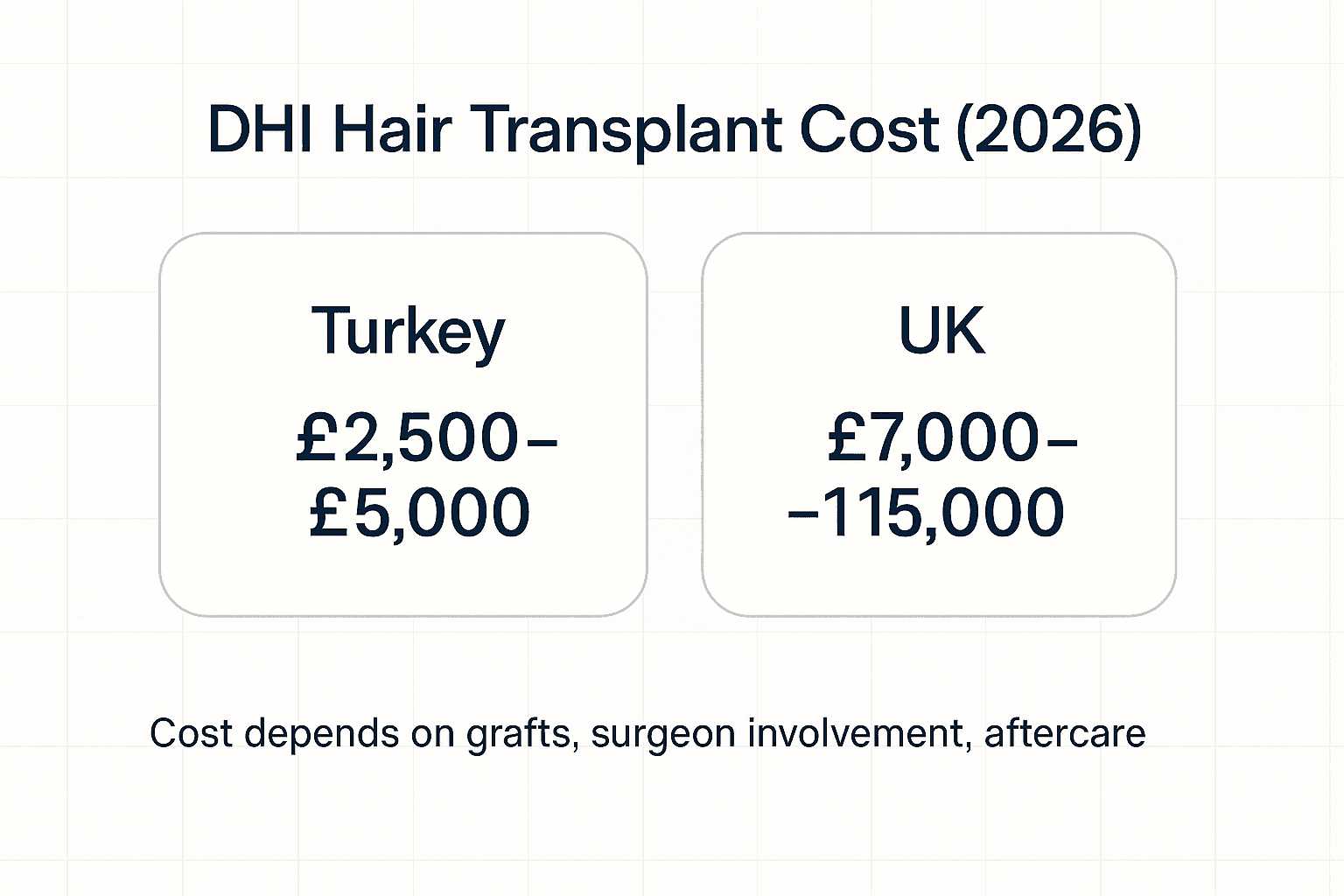
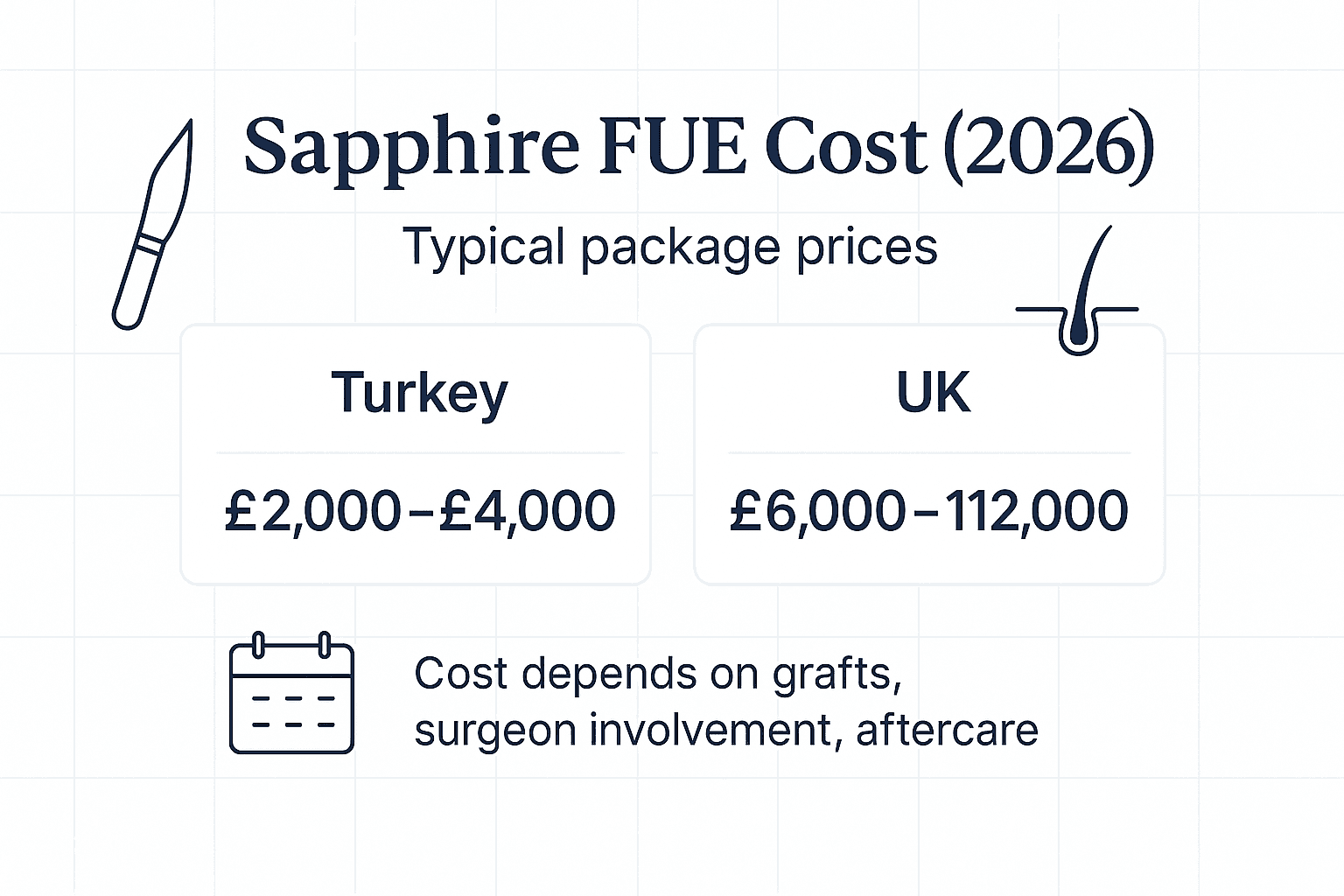
| UK | Per graft or graft bands | £3,000 to £10,000+ | Higher staffing costs, more surgeon time per patient, structured aftercare; can be higher for large sessions or premium surgeons |
| Turkey (Istanbul and other hubs) | Package / per day | £1,500 to £3,500 | High-volume model in many clinics, low labour costs, packaged logistics; quality varies massively |
Anchor point from an official UK source: the NHS states hair transplants in the UK can cost £1,000 to £30,000 depending on extent, type of procedure, and the quality of the clinic and team. [1]
Table 2: Per-graft vs package pricing (what can go wrong)
| Pricing model | Common in | Pros | Cons / watch-outs |
|---|---|---|---|
| Per graft (e.g. £2.50 to £6 per graft) | UK, some EU clinics | You can compare like-for-like; easier to map cost to graft plan | Encourages “graft inflation” if the clinic is sales-led; you must ask how grafts are counted and documented |
| Graft bands (e.g. up to 2,000 / 3,000 / 4,000) | UK and EU | Predictable budgeting | The band edges can be arbitrary; ask what happens if you need fewer grafts than the band |
| Package (flat fee) | Turkey, some medical tourism brokers | Easy to understand; sometimes includes hotel and transfers | Can conceal a high-volume workflow, unclear graft numbers, unclear surgeon involvement, and lots of paid “add-ons” |
| Per day | Some overseas clinics | Aligns with operating time | Patients assume “more hours = better”, but speed can reduce quality if teams rotate or fatigue |
A useful test is to ask: “If I end up needing fewer grafts than planned, does the price go down?” and “If I need more, what happens?” The answer tells you whether it is a medical plan or a sales package.
What drives the cost of FUE (and what should not)
1) Graft count and complexity
More grafts generally cost more, but it is not linear.
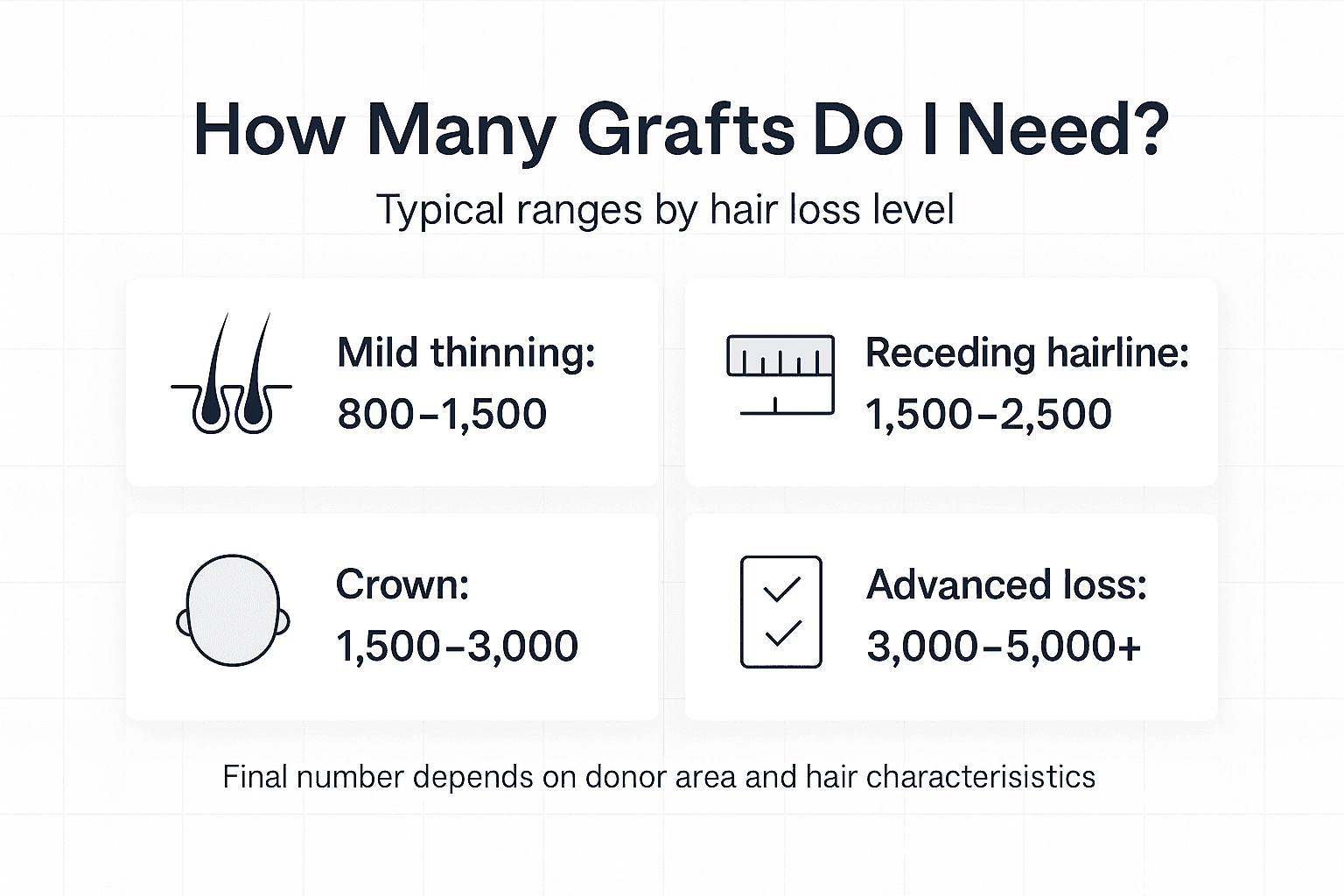
- A 1,500–2,000 graft case can be a fairly standard frontal restoration.
- A 2,500–3,500 graft case often includes mid-scalp density.
- A 4,000+ graft plan can be a large session, sometimes requiring two days or multiple sessions.
Complexity factors include:
- diffuse thinning (harder to implant without shock loss)
- poor donor density or limited safe donor area
- curly hair (often favourable cosmetically, but can complicate extraction angles)
- previous transplants or scarring
- hairline design requirements (soft, irregular micro-zig-zag vs straight “wall”)
2) Surgeon involvement (this is a key differentiator)
In the UK, the NHS advises you to ensure the doctor is registered with the GMC and encourages checking professional bodies such as BAHRS. [1]
Practically, you want to know:
- Who designs the hairline and recipient sites?
- Who does the anaesthetic?
- Who performs the extraction?
- Who makes the incisions (recipient sites)?
- Who places the grafts?
International hair restoration bodies have highlighted the harm caused by fraudulent, illicit clinics that lure patients with low prices and travel packages. [2]
3) Clinic workflow: one patient per team per day vs production-line
A clinic can lower prices by:
- running multiple patients per day
- using large technician teams with minimal doctor involvement
- keeping consultation time short
- cutting down on aftercare and follow-up
That does not automatically mean “bad”, but it raises the bar for transparency.
4) Aftercare and “what happens if something goes wrong”
This is where UK vs overseas becomes a real cost difference.
If you are in the UK, follow-up and complication management are logistically easier. If you have surgery abroad, you might be managing early problems (infection, swelling, poor wound healing) after you have already flown home.
The ISHRS has documented consequences of illegal or poorly performed hair transplants including permanent visible scarring, infection, thin patches, bald spots, and over-harvested donor areas which can be difficult to correct and may require multiple procedures. [2]
Ready to Compare Clinics?
Get verified quotes from top-rated hair transplant clinics. Compare prices and reviews in minutes.
“What’s included” in an FUE quote (and what often is not)
What should be included (minimum expectations)
Whether you are choosing the UK or Turkey, a serious FUE quote should clearly include:
- Consultation (ideally with the surgeon who will operate)
- a written surgical plan (graft estimate range, areas, hairline design)
- pre-op bloods / checks where appropriate
- procedure day costs: theatre time, local anaesthetic, consumables
- graft handling protocol (how they are stored, how long out of body)
- post-op kit (saline spray, shampoo, written instructions)
- medications (or at least a clear list and expected cost)
- scheduled follow-up (in-person or remote) and a route for urgent queries
Common hidden costs (UK and Turkey)
Hidden costs are not always “scams”, but they can change the real total.
In the UK, watch for:
- consultation fee that is “refundable” only if you book
- extra charges for very long sessions, special anaesthesia needs, or complex cases
- PRP as an upsell (often marketed aggressively)
- travel and accommodation if you are going to London or a major city
In Turkey, watch for:
- medications not included (antibiotics, pain relief, swelling control)
- “needle-free anaesthesia”, “sapphire”, “stem cell”, “ozone”, “VIP” add-ons
- extra nights if you need more than one day of surgery
- upgraded hotel (basic hotel included, but you are nudged to pay more)
- extra cost for a translator on medical review (rare, but happens)
- revision policy: what counts as a “free touch-up” vs a paid second procedure
The second-trip nuance (patients do not budget for this)
When you go abroad for a hair transplant, it is easy to budget for:
- flights
- hotel
- transfers
- the procedure
But you should also budget for the possibility of a second trip, because:
- if you need an in-person assessment for complications, remote WhatsApp photos are limited
- some clinics’ “guarantees” are only valid if you return for review
- if you need a small corrective procedure, you may prefer the same surgeon (if you trusted them)
A second trip can add:
- another 2 to 4 days of travel
- additional time off work
- new flights (which can be expensive at short notice)
- another hotel stay
If you are choosing Turkey mainly because the price is lower, it is worth asking yourself: “If I had to fly back once, would I still feel comfortable with the decision?”
UK vs Turkey: realistic total-cost examples
These examples are simplified, but they show how the “true total” can shift.
Example A: 2,500 graft FUE in the UK
- Procedure (2,500 grafts): £6,000
- Consultation: included
- Medications: £50 to £150
- Travel and 1 hotel night (if needed): £150 to £300
Estimated total: £6,200 to £6,450
Example B: 2,500 graft “package” in Turkey
- Package: £2,200
- Flights: £200 to £500
- Extra nights: £80 to £250
- Medications and add-ons: £80 to £300
- Time off work: varies (often the real hidden cost)
Estimated total: £2,560 to £3,550 (plus time off work)
Turkey can still be cheaper, but the gap narrows when you budget honestly.
Red flags that matter more than price
The NHS warns to be cautious about online advertising and to check clinic registration and surgeon credentials. [1]
The ISHRS describes fraudulent clinics “luring unsuspecting patients” with false or misleading advertising, rock-bottom prices, and tempting travel packages, with potentially devastating results. [2]
Here are practical red flags you can use in real conversations.
Red flag 1: You cannot name the surgeon who will operate
If the clinic will not confirm:
- the surgeon’s full name
- their registration (GMC in the UK) [1]
- who performs extraction and incision steps
…you cannot properly consent.
Red flag 2: “Unlimited grafts” as a selling point
Nobody has unlimited safe donor supply.
Unlimited graft marketing often correlates with:
- aggressive harvesting
- poor donor management
- a “numbers-first” approach
Red flag 3: More focus on closing the sale than planning the hairline
A good clinic talks about:
- your future hair loss pattern
- whether you may need a second procedure in 5 to 10 years
- donor conservation
A sales-led clinic talks about:
- discounts ending today
- deposits to “secure the surgeon”
- bundles and upgrades
Red flag 4: A clinic that treats many patients per day but won’t explain staffing
Ask:
- how many patients are treated per day
- how many technicians are assigned to you
- whether the team is dedicated to you or shared
Transparency matters.
Red flag 5: “No risk, guaranteed results” language
Hair transplants have risks and variability.
The NHS notes that no treatment is 100% effective and the decision is significant. [1]
Be wary of absolute promises.
Questions to ask a clinic before you pay a deposit
Copy and paste these.
Surgical plan and grafting
- How many grafts do you estimate, and what is the range?
- How will grafts be counted and documented on the day?
- Can you show donor assessment photos and explain the safe donor area?
- What density are you aiming for in the hairline vs mid-scalp?
Who does what (this is non-negotiable)
- Who performs extraction? Who makes recipient sites? Who implants?
- How many patients will the surgeon oversee on the day?
- How many staff will work on me, and will they rotate?
Safety, regulation, and aftercare
- What is your infection protocol and what antibiotics are included?
- What follow-up schedule do you offer, and who responds if I have a problem?
- If I am unhappy at 12 months, what is the revision policy and what is excluded?
If you are having surgery in England, the NHS recommends checking whether a clinic is registered with the CQC and that doctors are registered with the GMC. [1]
How to compare clinics without falling for marketing
Step 1: Compare the plan, not the headline price
You want a like-for-like comparison:
- graft estimate range
- technique (standard FUE vs DHI implantation)
- who performs which steps
- operating time and staffing
- aftercare schedule
Step 2: Use photos properly
Good photo evidence:
- consistent lighting and angles
- donor photos (not just the hairline)
- 12-month results, not 3-month “fluff”
Be careful with:
- wet hair tricks
- heavy fibres or styling
- results that look identical across patients
Step 3: Understand that “sapphire”, “ice”, “VIP” are not outcomes
These terms are not inherently meaningful. What matters is:
- surgeon skill
- planning
- graft survival
- safe donor management
FAQs (real searches people type)
1) How much does an FUE hair transplant cost in the UK in 2026?
UK costs vary by graft count and clinic model. In practice, many patients see quotes in the £3,000 to £10,000+ range, while the NHS notes a much wider range (£1,000 to £30,000) depending on extent and clinic quality. [1]
2) How much is a hair transplant in Turkey compared with the UK?
Turkey is often advertised as cheaper, commonly through package pricing. The true comparison depends on graft plan, surgeon involvement, and total travel-related costs. If you need a second trip for follow-up, the cost advantage can shrink.
3) Is it cheaper per graft in Turkey?
Often, yes on paper. But package clinics may not document graft counts clearly, and the per-graft comparison is only meaningful if you know the true graft number and who performed the key steps.
4) What is a normal price per graft for FUE?
In the UK, per-graft rates vary by clinic and surgeon involvement. A safer approach is to compare the total cost for your graft plan and scrutinise what is included and who does the work.
5) Why do some clinics offer “unlimited grafts” packages?
It is marketing. Donor hair is finite. “Unlimited grafts” is a red flag if it replaces proper donor assessment and long-term planning.
6) What is included in a Turkey hair transplant package?
Typically: procedure, transfers, and hotel. Medications, PRP, extra nights, and some “VIP” services may be add-ons. Always ask for a written inclusions list.
7) What are the biggest red flags for hair transplant clinics?
Not naming the operating surgeon, pressure-selling discounts, unclear staffing, guaranteed results language, and vague graft counting. The NHS also warns to be careful about advertising and to check clinic registration and doctor credentials. [1]
8) Can I get a refund or a free revision if growth is poor?
Policies vary. Ask what “poor growth” means, how it is measured at 12 months, and what is excluded (medications, travel, additional grafts, scarring repair).
9) How many grafts do I need for an FUE hair transplant?
It depends on your pattern of loss, hair calibre, donor density, and desired hairline. A reputable clinic will provide a range and explain the design choices.
10) Is an FUE hair transplant safer in the UK?
Safety is about standards, transparency, and who performs the procedure. In the UK you can verify clinic registration (CQC in England) and the surgeon’s registration (GMC). [1] International bodies also warn about fraudulent, illicit clinics worldwide that use misleading advertising and low prices. [2]
Sources
- NHS. Hair transplant (includes UK cost range, CQC registration advice, and GMC registration guidance). https://www.nhs.uk/tests-and-treatments/cosmetic-procedures/cosmetic-surgery/hair-transplant/
- International Society of Hair Restoration Surgery (ISHRS). “World Hair Transplant Repair Day” … Shines Light on Proliferation, Dangers of Black-Market Hair Transplant Clinics Worldwide (Oct 2025). https://ishrs.org/fifth-hair-transplant-repair-day/
Ready to Start Your Medical Journey?
Compare clinics, read verified reviews, and get personalised quotes from top medical facilities worldwide. Save up to 70% on your treatment.